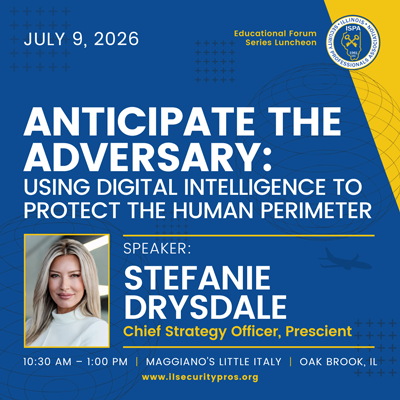
Event Information

Date: July 9, 2026
Location: Maggiano’s Little Italy

Speaker: Stefanie Drysdale

Program Title:
Anticipate the Adversary: Using Digital Intelligence to Protect the Human Perimeter


Program Description

Modern threats rarely begin with a physical act. Long before a breach, confrontation, or attack occurs, sophisticated adversaries often conduct extensive digital reconnaissance to identify vulnerabilities, map organizations, and target key personnel.


Drawing on experience in digital forensics, insider threat investigations, executive protection, and corporate fraud, Stefanie Drysdale will provide security professionals with a practical understanding of how adversaries gather intelligence and exploit digital exposure. The presentation explores how organizations can shift from reactive security strategies to proactive, intelligence-led protection models designed to identify risks before they escalate into physical incidents.


Attendees will gain insight into the investigative patterns, warning signs, and strategic gaps that frequently precede security failures, along with emerging risks tied to AI-powered social engineering, deepfake impersonation, voice cloning, and nation-state targeting.


Learning Objectives

After attending this presentation, participants will be able to:

  • Describe the adversary’s reconnaissance process — the specific intelligence sources, platforms, and methods used to research organizations and their people — and explain how that process informs a more proactive and intelligence-led approach to physical security program design
  • Recognize the digital warning signals that consistently precede physical security incidents, insider threat activity, and targeted fraud — and articulate why those signals are routinely missed by even well-resourced security programs
  • Evaluate your organization’s current threat assessment framework against the reality of how modern adversaries develop their targeting intelligence — identifying the specific gaps that create exposure before a threat becomes visible in the physical environment
  • Assess the risk created by the personal digital exposure of key personnel and their families — and make an informed case to organizational leadership for incorporating executive digital protection into the security program as an institutional risk management priority rather than a personal benefit
  • Apply a current threat intelligence lens — including the implications of AI-powered social engineering, voice cloning, deepfake impersonation, and nation-state targeting of US organizations — to your security program’s personnel risk framework and leadership communications strategy