Event Information
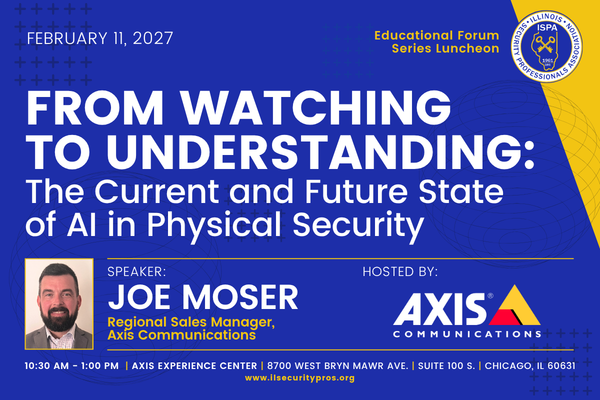
Date:
February 11, 2027
Location: Axis Experience Center
8700 West Bryn Mawr Ave. Suite 100 S.
Chicago, IL 60631
Speaker: Joe Moser
Program Title:
The Current State and Future of AI in Physical Security
Program Description
Artificial intelligence has moved from a product feature to a top project priority for security leaders. In the industry’s largest annual survey of more than 7,300 physical security professionals, the share naming AI and large language models a priority more than doubled in a single year, yet actual deployment still lags well behind interest. At the same time, new capabilities such as natural-language video search and agentic AI are arriving alongside Illinois’ Biometric Information Privacy Act (BIPA), shifting federal and international regulation, new cybersecurity risks, and AI-driven hardware price increases. Security professionals are being asked to make significant decisions in a market crowded with claims.
This manufacturer-agnostic session separates what AI reliably delivers today from what is still maturing. It examines where AI processing should run (edge, on-premises, or cloud), what vision-language models and agentic AI can and cannot do, and how much autonomy security teams should grant them. It reviews BIPA obligations following the 2024 damages amendment and the 2026 Seventh Circuit ruling, the EU AI Act, NDAA Section 889, cybersecurity and video evidence integrity, and the impact of the AI data-center boom on equipment costs and lead times. The session closes with a three-horizon industry outlook, the changing role of the security operator, and practical tools attendees can apply to their own programs regardless of which manufacturers they use.
Learning Objectives
After attending this session, the attendees will know:
- Objective 1: Identification of the AI capabilities proven in production today, including object classification, verified intrusion alarms, forensic search, license plate recognition, and operational analytics, and the trade-offs of running AI at the edge, on premises, or in the cloud.
- Objective 2: Explanation of emerging technologies, including vision-language models for natural-language video search and agentic AI, along with their current limitations and appropriate levels of human oversight.
- Objective 3: Overview of the legal and regulatory landscape affecting AI deployments, including Illinois BIPA after the 2024 amendment, the EU AI Act, NDAA Section 889, and evolving federal and state AI policy.
- Objective 4: Assessment of the cybersecurity, evidence-integrity, and supply-chain risks AI introduces, including the effect of AI-driven component shortages on project budgets and lead times.
- Objective 5: Application of a vendor-neutral framework, including eight questions to ask any AI vendor and a four-step adoption roadmap, to attendees’ own security programs.
Speaker Bio
Joseph Moser
Joseph Moser is a Regional Sales Manager with Axis Communications, where he works with security integrators, consultants, and end users to apply video, audio, access control, and analytics technologies to real-world security challenges. He brings more than two decades of experience spanning military service, security operations, information technology, and security engineering. Joseph began his career in the U.S. Army, serving from 2002 to 2008 as an Infantry Squad Leader responsible for leading and training soldiers. He then spent more than eight years as Security Manager for a multi-campus healthcare organization, managing hospital security operations. As Director of IT for a security systems integrator, he led IT infrastructure and field service engineering for five years. He went on to serve as Security Systems Manager for a major Chicago convention center and as a Consulting Engineer with a security consulting and engineering firm, designing security systems for clients before joining Axis. Having worked as an end user, an IT leader, a consultant, and now a manufacturer representative, Joseph brings a practical perspective on how security technology performs in the field.